Optimize for Perplexity — Brand Monitoring & AI Citations
Perplexity builds its answers from web search results and shows the sources it used, so whether its crawler can reach your pages decides whether you can be one of them. 99Visibility asks Perplexity your buyers' prompts with web search on, records every source it cites, and checks robots.txt and your firewall for both of Perplexity's crawlers.
Last reviewed:
How Perplexity works for AI visibility
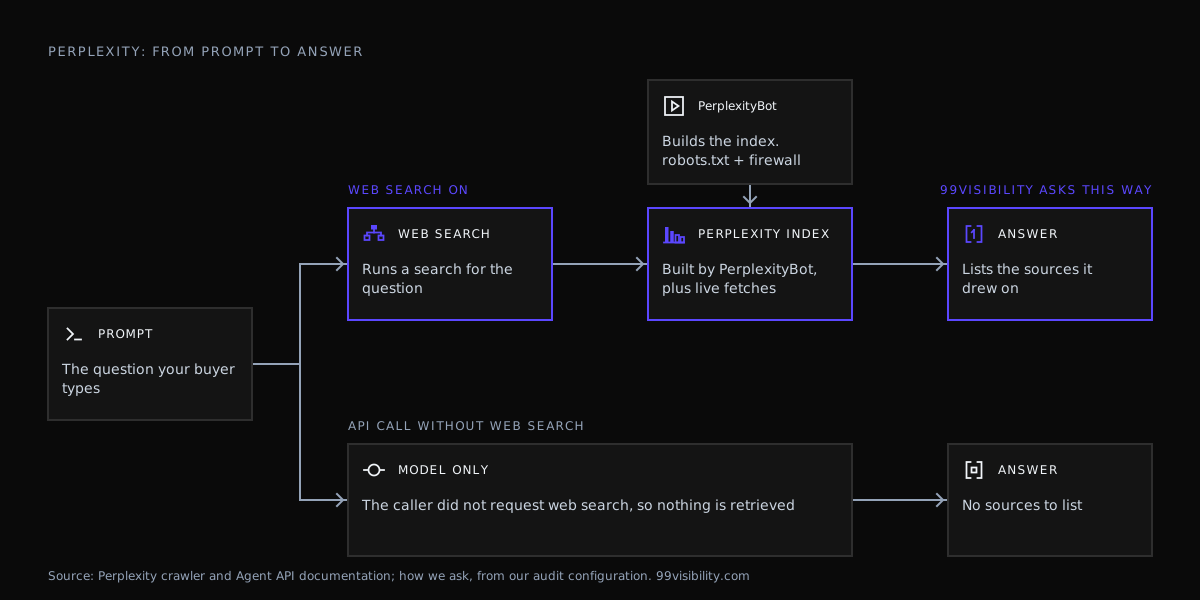
Search first
Perplexity answers by running a web search and writing from the results. Through its Agent API, web search is a tool the caller has to request; without it, the model answers with no retrieval at all. We request it on every Perplexity call.
Its own index
PerplexityBot is the crawler that builds Perplexity's search index. Perplexity states it is not used to crawl content for AI foundation models, so blocking it costs you search and opts you out of no training.
Live fetches skip robots.txt
Perplexity-User fetches a page when a user's question calls for it, and Perplexity states it "generally ignores robots.txt rules". A robots.txt line is not a reliable way to keep it out; a firewall rule is.
How it cites
Each answer comes with the sources it drew on. Through the API, every search result carries a url, title, snippet, date and last_updated field, kept apart from the answer text.
JavaScript
Perplexity does not document whether PerplexityBot runs JavaScript. Vercel's crawler study tested OpenAI's and Anthropic's crawlers, which do not, so the safe assumption is that facts loaded by scripts may not be read.
The crawlers that reach Perplexity
PerplexityBot (Perplexity search index)
Your pages leave the Perplexity search index. Perplexity states this crawler is not used to crawl content for AI foundation models — it is search only.
Vendor-documented: docs.perplexity.ai →Perplexity-User (Perplexity on-demand browsing)
Perplexity states this fetcher generally ignores robots.txt rules, so a robots.txt block is not a reliable control here — only the firewall verdict matters.
Vendor-documented: docs.perplexity.ai →
What is not documented
- How Perplexity ranks or selects its sources. It publishes no ranking factors.
- How often PerplexityBot recrawls a page, and so how long a fix takes to show. Re-run the audit to find out for your own pages.
- Which model the app uses for a given answer. Its default auto-routes across several vendors' models; perplexity/sonar, the API model we call, is Perplexity's own, so read our column as a proxy for the app.
- Whether a cited source shaped the answer. A citation proves the page was listed, not how much of it was used.
What 99Visibility does for Perplexity
- How we ask it
- Perplexity API, perplexity/sonar, with web search
- Web search in our audit
- On. Answers come from what it finds on the web when it answers
- Weight in the score
- 18% of platform coverage
- Plans
- Starter ($49/mo) and up
- Crawlers checked
- PerplexityBot, Perplexity-User: robots.txt, plus a firewall probe for each one that crawls
Asks Perplexity with search on
Each keyword goes to the Perplexity Agent API as perplexity/sonar, exactly as you typed it, with web search requested. Sonar is Perplexity's own search-tuned model and the closest one to the app we can pin. Perplexity is on Starter ($49/mo) and up.
Records what it cites
Every source Perplexity cites is stored with the answer, and the citation rate counts the share that point to your site. When the engines name a tracked competitor and not you, the fix list names the domains cited on those prompts, so you know which pages shape the answer.
Checks both Perplexity crawlers
The access check reads robots.txt for PerplexityBot and Perplexity-User and requests your page as each one. A robots.txt block on PerplexityBot is ranked critical, because Perplexity documents that your pages leave its index; a firewall that blocks it while robots.txt allows it is ranked high.
Flags wrong facts
Every Perplexity answer is read against the price, founding year, location and features in your brand profile. Each flag puts the claim beside your fact, with a severity of critical, moderate or minor.
A platform note in the fix list
When the Perplexity column scores more than 20 points under your overall score, the fix list adds a note for it. It tells you to check that the page is reachable by PerplexityBot, readable without JavaScript and free of snippet controls, then to look at what Perplexity cited instead.
Agent V for Perplexity
Agent V is the assistant in your dashboard, on every plan. It reads your audits, your accuracy flags and pages on your own site, so you can ask what an engine said for a prompt and which fix applies.
Ask for robots.txt lines and V drafts groups for the AI crawlers, PerplexityBot among them, each with a note on what it controls. It also tells you that robots.txt will not help if a firewall or bot rule blocks the same crawler at the edge.
V can also check a page on your site or run a new audit. Each change it proposes shows up as a "V wants to" card and does nothing until you confirm, and V never edits your site: drafts are text you paste yourself.
Perplexity optimization: what to fix first
Allow PerplexityBot in robots.txt. It is a search crawler, not a training one, so a block costs you Perplexity's index and gains you nothing on training.
Check that your firewall answers 200 to PerplexityBot. Perplexity publishes its IP ranges at https://www.perplexity.ai/perplexitybot.json; a bot-protection rule that answers 403 removes you without any trace in robots.txt.
Do not count on robots.txt to keep Perplexity-User out. Perplexity states it generally ignores robots.txt, so if you need it blocked, block it at the firewall.
Serve your key facts in the HTML your server sends. Perplexity does not document JavaScript support, and OpenAI's and Anthropic's crawlers did not run scripts when tested.
Keep each fact the same on every page. When your pricing page and your FAQ disagree, a search can retrieve either one.
Perplexity optimization FAQ
How does Perplexity choose which sources to cite?
Does optimizing for Perplexity also help with SEO?
How is Perplexity different from ChatGPT in your audit?
Why is Perplexity not on the Free plan?
Sources
PerplexityBot is for search indexing, "not used to crawl content for AI foundation models."
Source: Perplexity crawler documentation →Perplexity-User: "this fetcher generally ignores robots.txt rules."
Source: Perplexity crawler documentation →Through the Agent API, web search is a tool the request must include. Each search result returns url, title, snippet, date and last_updated.
Source: Perplexity Agent API reference →"Our experiments reveal that most current C-SEO methods are not only largely ineffective but also frequently have a negative impact on document ranking, which is opposite to what is expected."
Source: C-SEO Bench, arXiv:2506.11097 (NeurIPS 2025) →Topical relevance and context position are "the most reproducible levers", and "citation-oriented rewrites can impair retrieval."
Source: Critical survey of GEO, arXiv:2607.14035 (July 2026) →Related
- AI search research: what the evidence supports
- Free robots.txt checker for AI crawlers
- How Perplexity decides which sources to cite
- Cloudflare's AI crawler default and PerplexityBot
- GEO tool pricing
- AI visibility audit features
The other platforms we audit
See what Perplexity says about your brand
Perplexity is on Starter ($49/mo) and up, which starts with a 7-day trial. The Free plan audits ChatGPT and Google AI Overviews and checks AI crawler access, with no card.
Start for Free- ChatGPTMentioned, 2nd of 5 brands
- Google AI OverviewsNot mentioned
- PerplexityMentioned and cited as source [1]
- ClaudeSays $29/mo. Your pricing page says $49/mo.