Google Deindexed 2,000 AI Blog Posts. Copilot Kept Citing Them.
The fastest-sounding shortcut in generative engine optimization (GEO) is volume: generate a thousand articles in one click, publish them, and let AI search find them. OtterlyAI tested exactly that in 2026 and published the results. The short version: Google deindexed both sites without a word, and Microsoft Copilot kept citing them.
We went through the numbers Otterly published and charted them. The findings are worth knowing. The test is also smaller than its headline, and the part people quote most, the author box, is the part it can least support.
What Otterly ran
Two new domains about capybaras, capybaraverse.com and capybara-world.com, each loaded with roughly 1,000 AI-generated blog posts in one click. One variable was meant to differ: capybara-world.com showed an author box under every post, presenting a fictional wildlife biologist with more than 15 years of field experience. capybaraverse.com had no author at all.
Otterly tracked four layers for about four months: Google Search Console, Bing Webmaster Tools, AI citations across seven engines (ChatGPT, Microsoft Copilot, Claude, Perplexity, Gemini, Google AI Overviews and AI Mode), and AI crawler visits. The original write-up was last updated on 2026-08-05 with a fourth month of data, and Otterly's CEO presented it at BrightonSEO San Diego in September.
What happened in Google
Both sites were removed. Neither got a warning: Otterly reports zero manual actions in Search Console on either domain. Whatever removed them was algorithmic, and Google does not say which system it was.
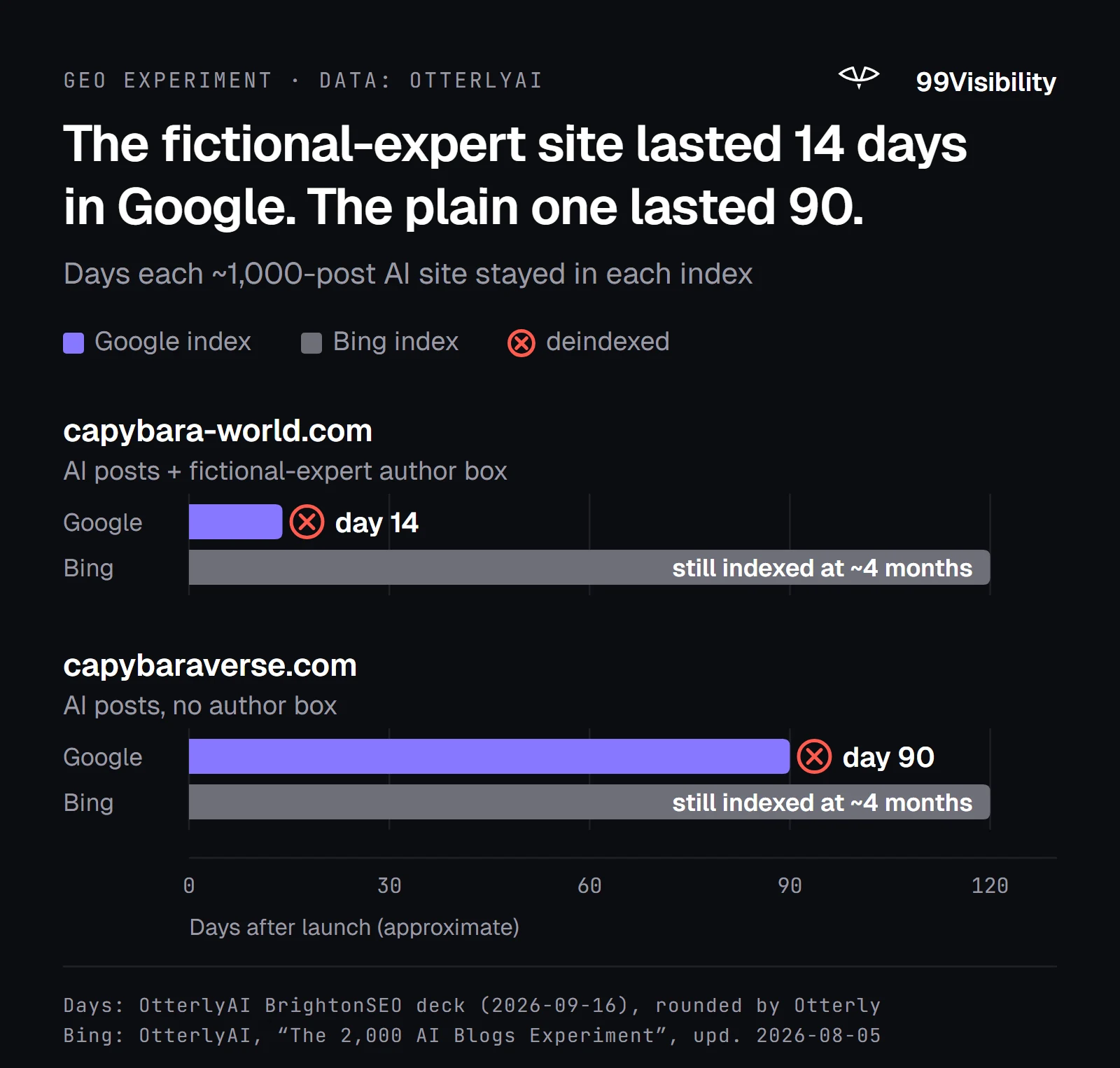
The order is the surprise. The site with the fictional expert went first, 14 days in. The site with no author lasted about 90. If author signals protected scaled AI content, it should have run the other way.
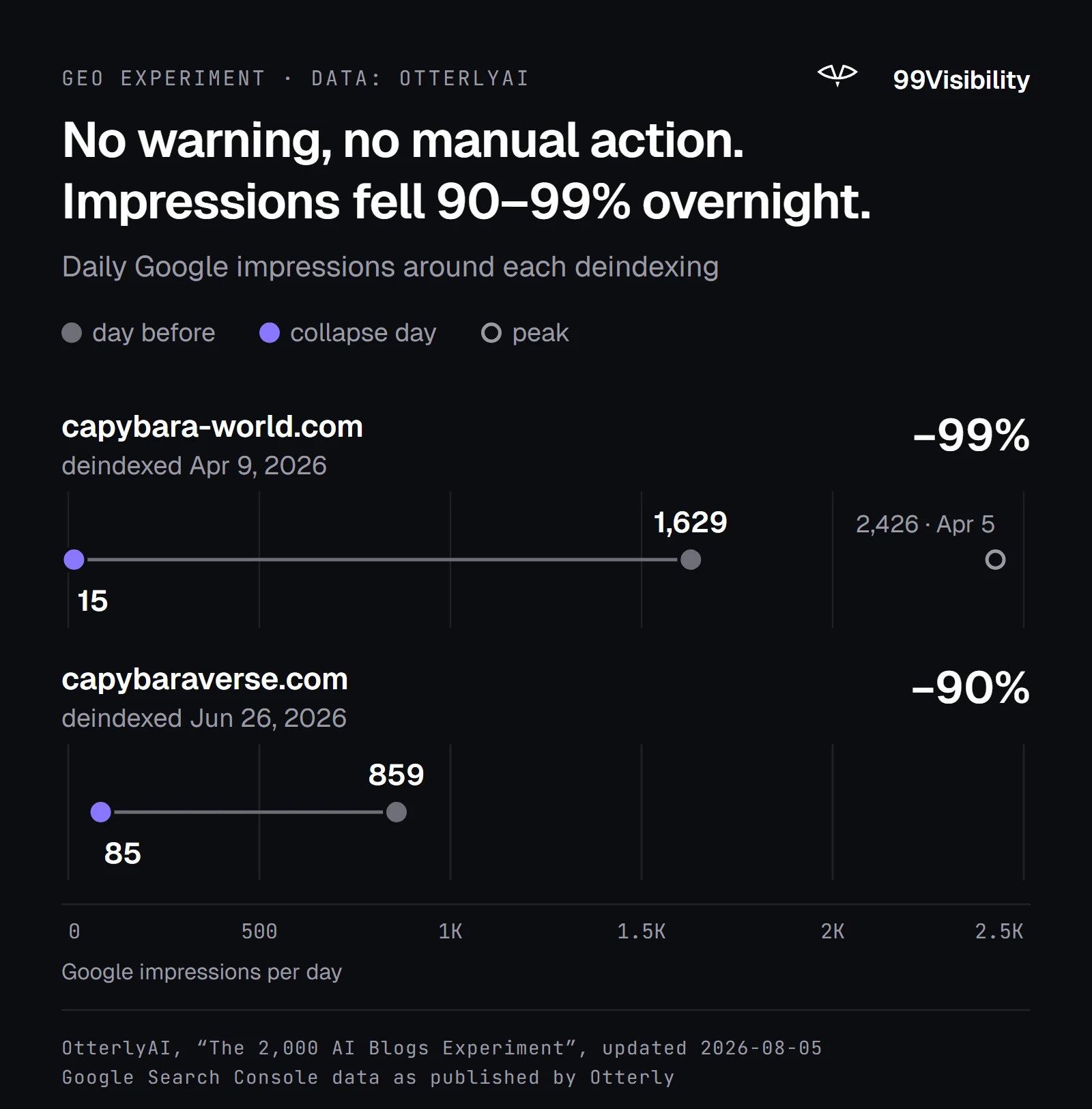
capybara-world.com peaked at 2,426 daily impressions on April 5, then fell from 1,629 to 15 on April 9. capybaraverse.com built up to more than 21,000 weekly impressions by mid-May before falling from 859 to 85 daily impressions on June 26, and to single digits after that.
None of this goes against Google's written policy. It is the policy. Google defines scaled content abuse as being "when many pages are generated for the primary purpose of manipulating search rankings and not helping users," and its first example is "Using generative AI tools or other similar tools to generate many pages without adding value for users." Its guidance on AI content is equally clear that the tool is not the problem: "Appropriate use of AI or automation is not against our guidelines."
The violation is volume without value, not the model that wrote it. A thousand thin pages on a new domain is the pattern Google describes, and the removal arrives with no notice in Search Console.
What happened in AI search
This is the half that makes the experiment worth reading. Losing Google did not end the sites' AI visibility. For capybara-world.com, it grew.
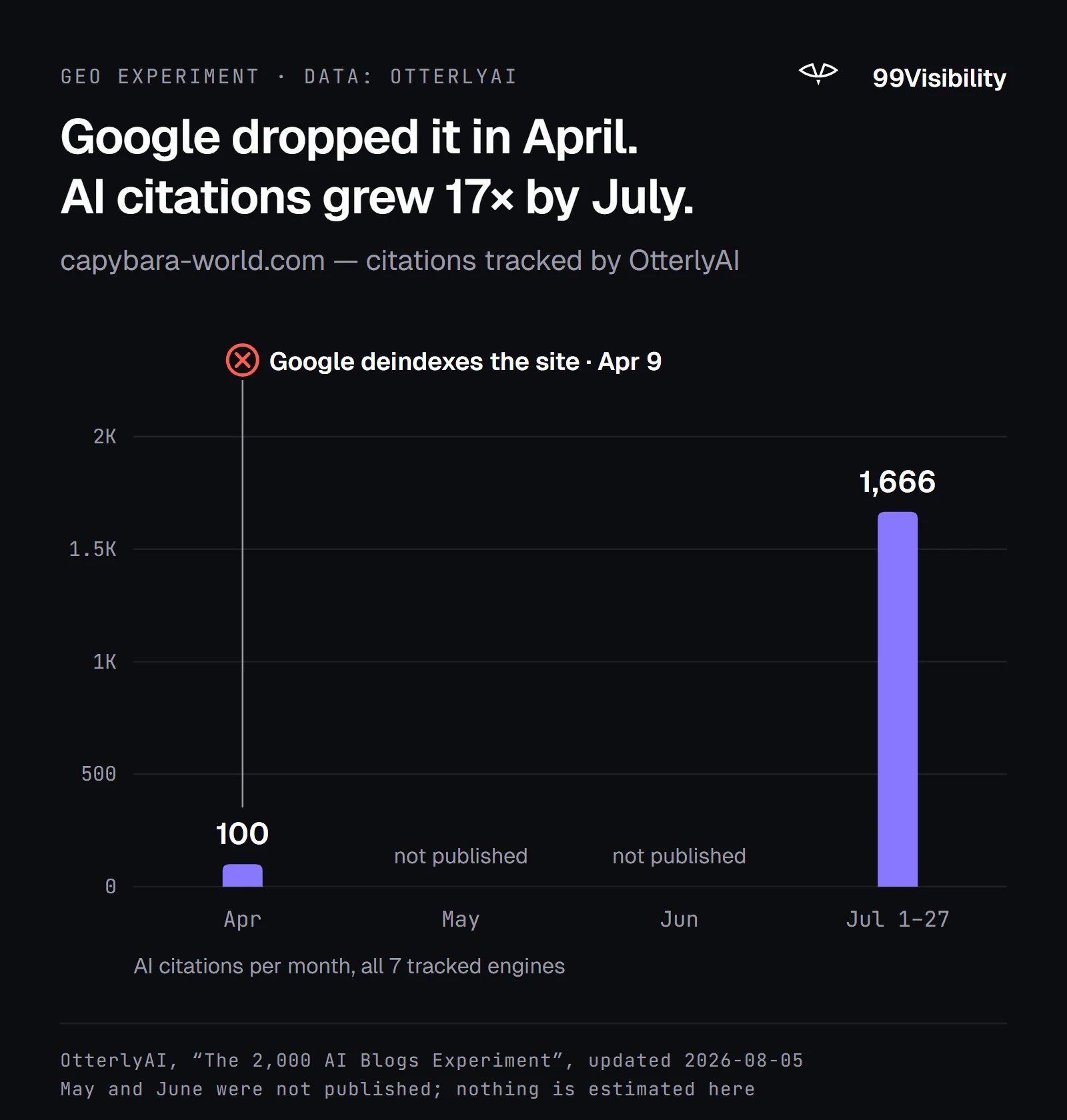
Otterly tracked 100 citations for capybara-world.com in April and 1,666 in the first 27 days of July, about 17 times as many, while the site was gone from Google's organic results.
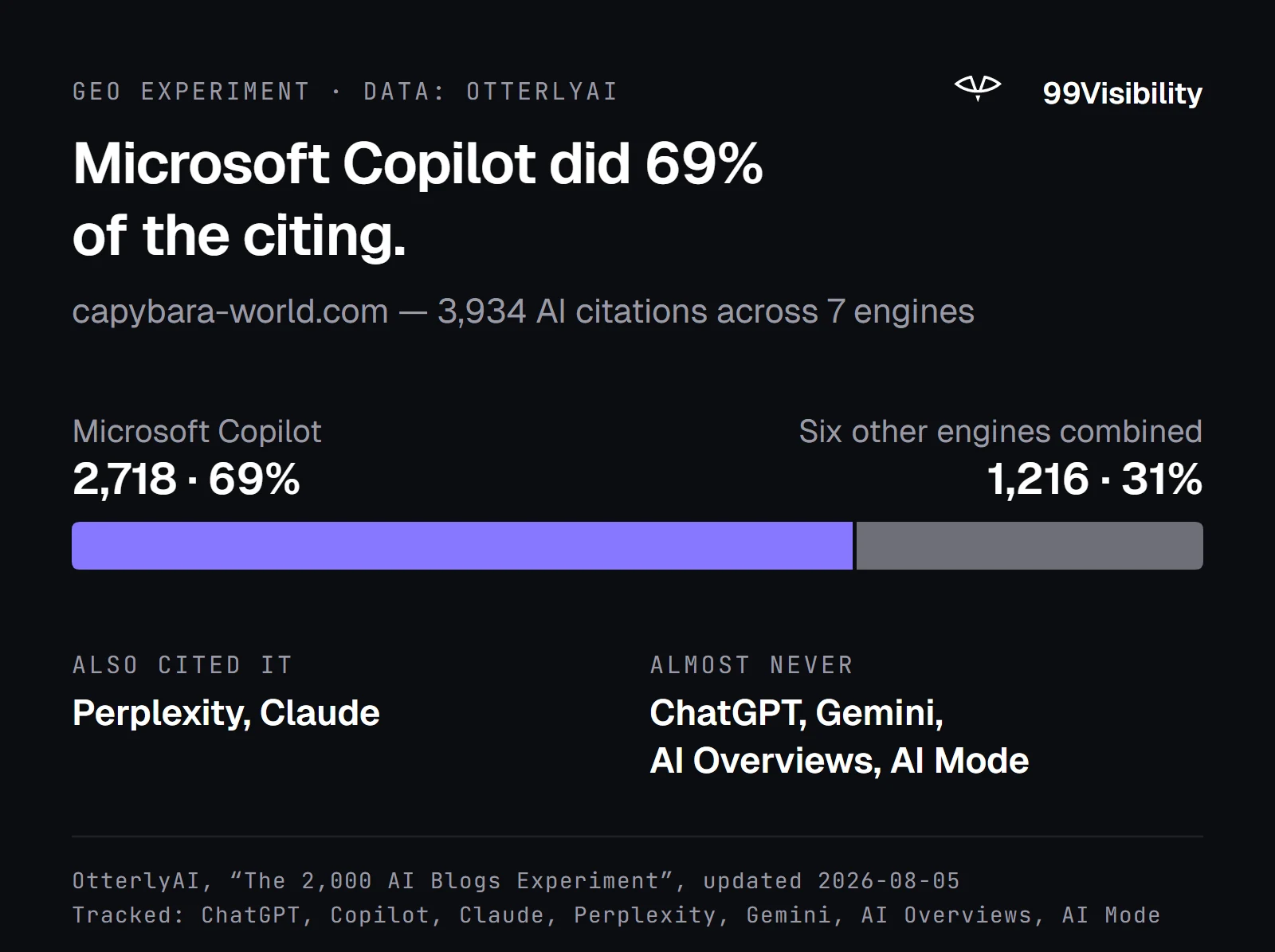
Most of those citations came from one place. Of the 3,934 citations Otterly tracked for capybara-world.com, 2,718 came from Microsoft Copilot. Perplexity and Claude cited the sites too. ChatGPT, Gemini, AI Overviews and AI Mode almost never did.
The split lines up with where each engine gets its pages:
| Engine | What happened in its index | What happened to citations |
|---|---|---|
| Microsoft Copilot (grounds on Bing) | Bing never deindexed either site. Combined Bing impressions grew every month, to 119,935 in July | 69% of capybara-world.com's tracked citations. Microsoft's own AI Performance report credits that site with 42,817 |
| Google AI Overviews, AI Mode, Gemini | Both sites removed from Google's index | Almost none |
| ChatGPT | ChatGPT's crawlers kept visiting the sites | Effectively zero, even while the sites ranked in Bing |
Two things follow. First, an engine cannot cite what its index no longer holds. Google states that a page must be "indexed and eligible to be shown in Google Search with a snippet" to appear as a supporting link in AI Overviews or AI Mode. Google removed these pages, and its AI surfaces stopped citing them. Bing kept them, and Copilot kept citing them.
Second, being indexed is necessary but not enough. "ChatGPT uses Bing" gets repeated as a strategy. In this test, ranking in Bing produced zero ChatGPT citations, even with ChatGPT's crawlers on the site.
One more number needs a caveat. Microsoft's report counted 42,817 citations for capybara-world.com, more than ten times the 3,934 that Otterly's prompt-based tracker logged. The time windows may not match, so do not read it as an exact ratio. It does show what any prompt sample is: a sample. Where an engine publishes its own count, that count sees more.
What this test does not prove
Otterly ran this in public and published the results, which is more than most GEO advice does. It is still one pair of sites, and the conclusions going around claim more than one pair can carry.
- One site per arm. The author box was not the only difference between the two sites. They had different domain names and everything else that comes with a separate domain. With one site in each arm, there is no way to separate the author box from that noise.
- No human-written control. Without a site publishing 1,000 human-written posts at once, the test cannot say whether Google reacted to AI text or to a thousand pages appearing overnight on a domain with no history. Google's policy targets the second, "no matter how it's created."
- The author box result is one data point. A fake expert going first is striking, and it fits Google's position that E-E-A-T is not a ranking factor. It does not show that author boxes hurt. One site cannot show that.
- A low-stakes topic. Capybara questions are informational, with little competition. Copilot citing capybara pages says little about whether it would cite a thin page over established sources in a commercial category.
- Citation counts depend on the prompts. A tracker counts answers to the prompts it asks. Otterly offers its experiment spreadsheet on request. Until the prompt list and raw counts are public, an outside reader cannot separate engine behaviour from prompt design.
- A vendor ran it. OtterlyAI sells AI visibility tracking, and so do we. Neither fact makes the data wrong. It is why replication matters.
What to do with it
The experiment does not change what has evidence behind it. It adds weight to it.
- Do not mass-publish to shortcut AI search. Google is still the largest channel, the removal was silent, and nothing in Search Console warned either site. Copilot citations do not make up for losing Google.
- Check your index status engine by engine. When Google dropped the sites, Google's AI surfaces stopped citing them. Look at Google Search Console and Bing Webmaster Tools separately. One being healthy tells you nothing about the other.
- Check that AI crawlers can reach you at all. Access comes before indexing. A robots.txt that allows a crawler while your CDN or firewall returns 403 removes you as quietly as a deindex does. See what Cloudflare's new AI crawler defaults changed.
- Measure each engine separately. One engine cited these sites thousands of times while four barely cited them. A single blended score would have hidden all of it. Our AI visibility audit scores each platform on its own for that reason.
99Visibility checks the first gate directly. We request your pages as each AI crawler, compare what comes back with what your robots.txt says, and flag every place the two disagree. Run a free audit to see which crawlers can actually reach you, or read our check of the AI-automation playbook for more tactics tested against primary sources.
The numbers behind the charts
Every figure above, with its source. Nothing is interpolated.
| Measure | Value | Source |
|---|---|---|
| capybara-world.com, days in Google's index | ≈14 | Otterly, BrightonSEO deck (2026-09-16) |
| capybaraverse.com, days in Google's index | ≈90 | Otterly, BrightonSEO deck (2026-09-16) |
| capybara-world.com, peak daily Google impressions | 2,426 (April 5) | Otterly write-up |
| capybara-world.com, daily impressions before → after collapse | 1,629 → 15 (April 9) | Otterly write-up |
| capybaraverse.com, weekly Google impressions by mid-May | 21,000+ | Otterly write-up |
| capybaraverse.com, daily impressions before → after collapse | 859 → 85 (June 26) | Otterly write-up |
| Both sites, combined Bing impressions in July | 119,935 | Otterly write-up |
| capybara-world.com, AI citations in April | 100 | Otterly write-up |
| capybara-world.com, AI citations July 1–27 | 1,666 | Otterly write-up |
| capybara-world.com, total tracked AI citations | 3,934 | Otterly write-up |
| … of which Microsoft Copilot | 2,718 (69%) | Otterly write-up |
| capybara-world.com, citations in Microsoft's AI Performance report | 42,817 | Otterly write-up |
Frequently asked questions
Does Google penalize AI-generated content?
Not for being AI-generated. Google says appropriate use of AI is not against its guidelines. It does act against scaled content abuse, meaning many pages produced to manipulate rankings without adding value. In this test it removed both 1,000-post AI sites from its index, and Otterly reports no manual action on either.
Can AI search engines cite a page Google has deindexed?
Yes, if they draw on a different index. In Otterly's test, Microsoft Copilot, which grounds its answers in Bing, kept citing the sites after Google removed them, and Perplexity and Claude cited them too. Google's own AI features almost never did.
Does an author box protect AI-generated content?
Nothing in this test suggests it does. The site with a fictional expert author box was deindexed after about 14 days and the site without one after about 90. With one site per arm, that does not prove author boxes hurt, but it is no evidence that they help.
Want more of our research in Google Search and AI Mode? Add us as a preferred source.


Get your AI visibility score
One number from 0 to 100: how often AI mentions you, how accurately, in what tone, and whether it cites you, scaled by the market weight of the platforms that name you.
Start Free Audit46/100
Named on 3 of 5 platforms× 0.76 coverage

Related Articles
E-E-A-T for AI Search: Which Signals Matter, and Which Are Myths
E-E-A-T is not a score any AI computes. What Google actually says, which signals matter most for AI visibility, the myths to drop, and eight checks worth running.
Should I Block AI Crawlers on Cloudflare? A Per-Bot Decision Guide
Block training crawlers if you object to training; keep search and agent crawlers open to stay in AI answers. What Cloudflare changed on September 15, 2026, per crawler, and how to check yours.
GEO Strategies: 20 Popular Tactics Checked Against the Evidence
We checked 20 popular GEO strategies against vendor docs and controlled studies. Access and accurate facts hold up; schema, llms.txt and AI-style rewrites don't.