How to Get Cited by ChatGPT: We Asked GPT-6 52 Questions and Logged Every Source
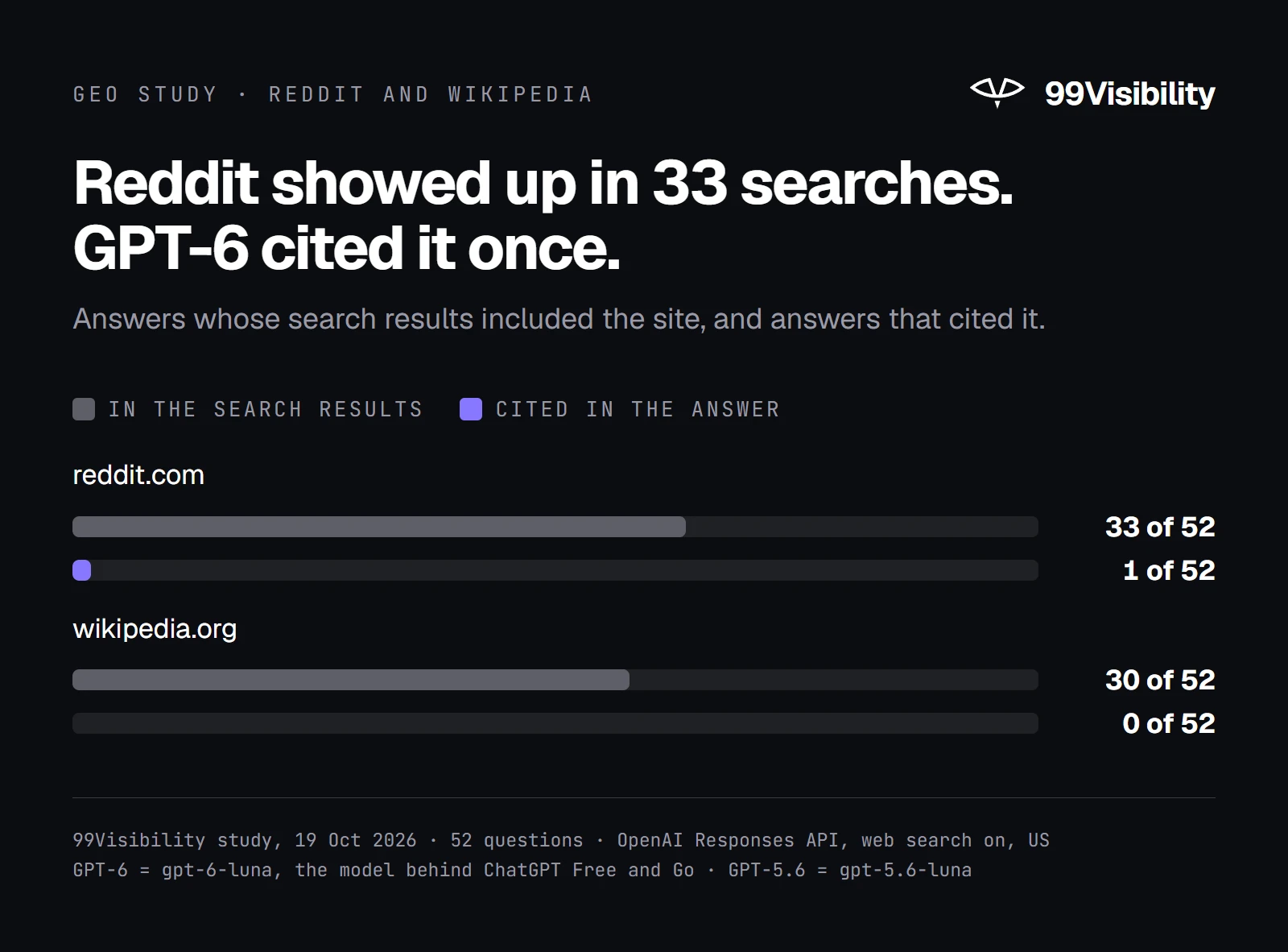
How to get cited by ChatGPT, measured rather than guessed: be the official source for the question, let OpenAI's crawler reach you, and put the specific answer on a specific page. On 19 October 2026 we asked GPT-6, the model ChatGPT now uses for its Free and Go plans, 52 ordinary questions with web search on. It searched the web for 51 of them, retrieved 2,277 pages and cited 146. Of those citations, 106 (73%) went to the official site of the product, company or service the question was about. Reddit appeared in its search results for 33 questions and was cited once. Wikipedia appeared for 30 and was never cited.
We asked GPT-5.6, the model GPT-6 replaced, the same 52 questions the same way. The new model searched more, read nearly twice as many pages, and moved its citations away from "best of" lists and directories toward the source itself. The full dataset is downloadable as a CSV.
The findings in one place
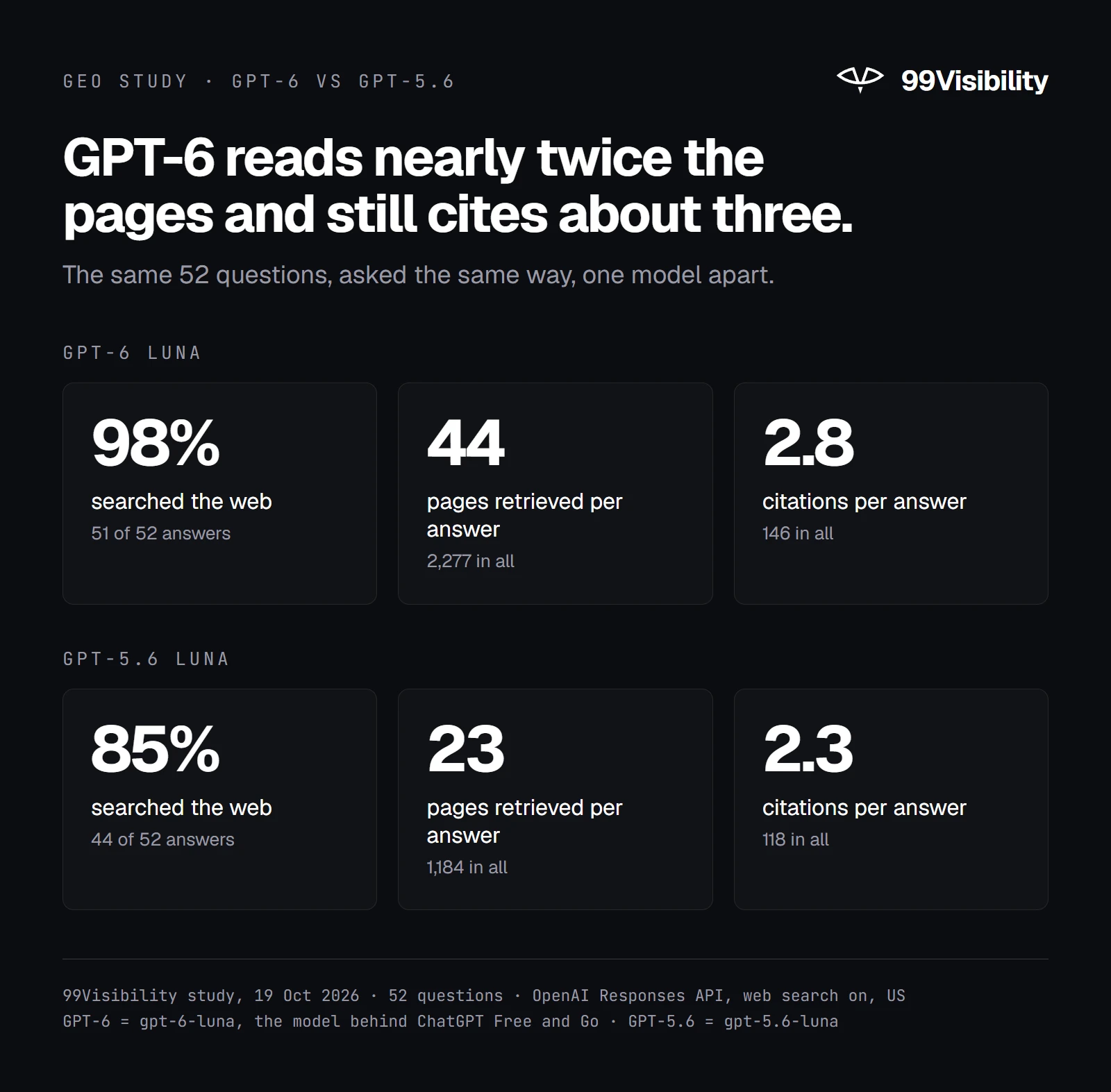
- GPT-6 searched for 51 of 52 questions (98%); GPT-5.6 searched for 44 (85%).
- GPT-6 ran 2.5 searches per answer and retrieved 44 pages; GPT-5.6 ran 0.9 searches and retrieved 23.
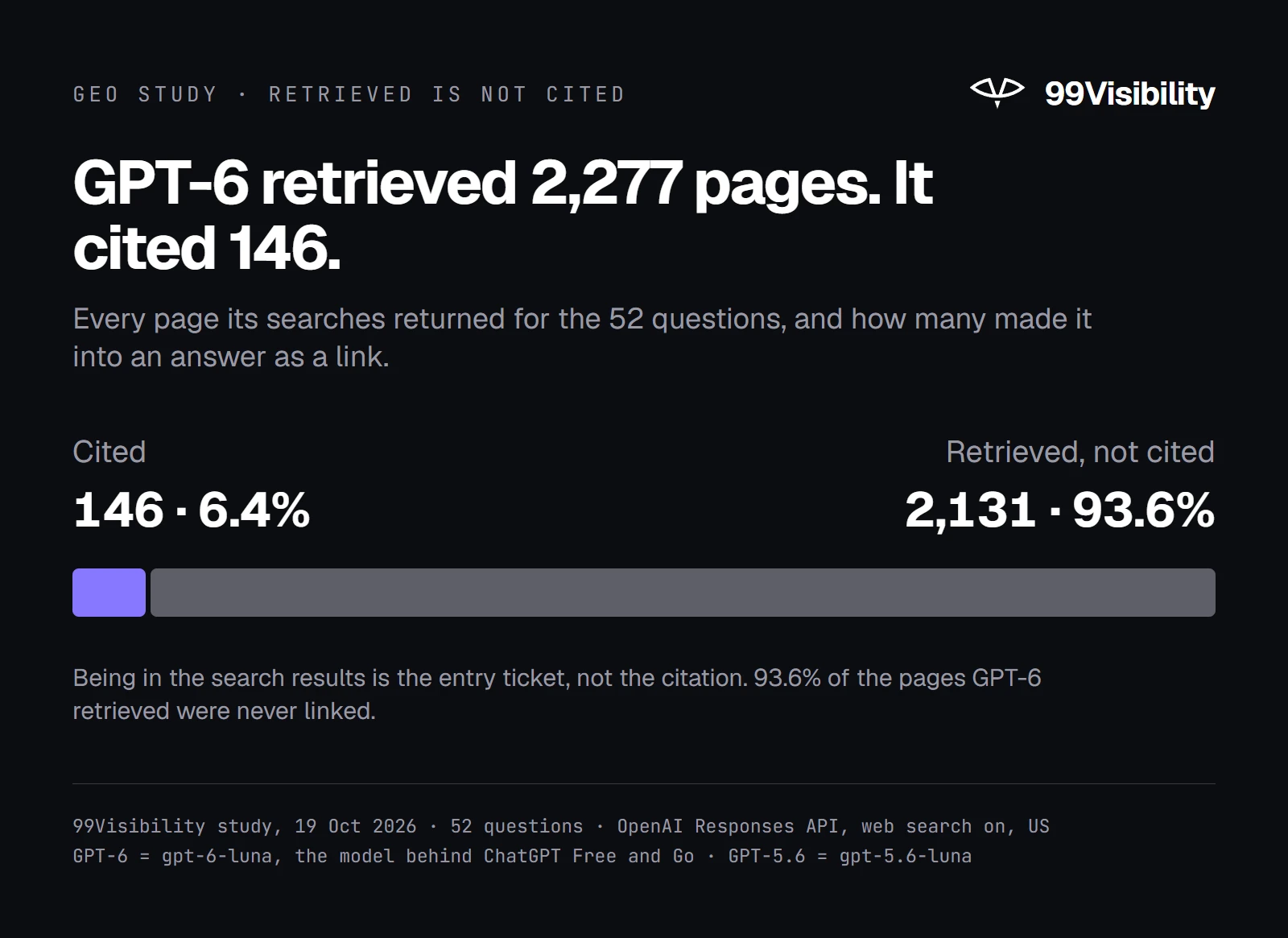
- GPT-6 cited 146 of the 2,277 pages it retrieved (6.4%). GPT-5.6 cited 118 of 1,184 (10.0%).
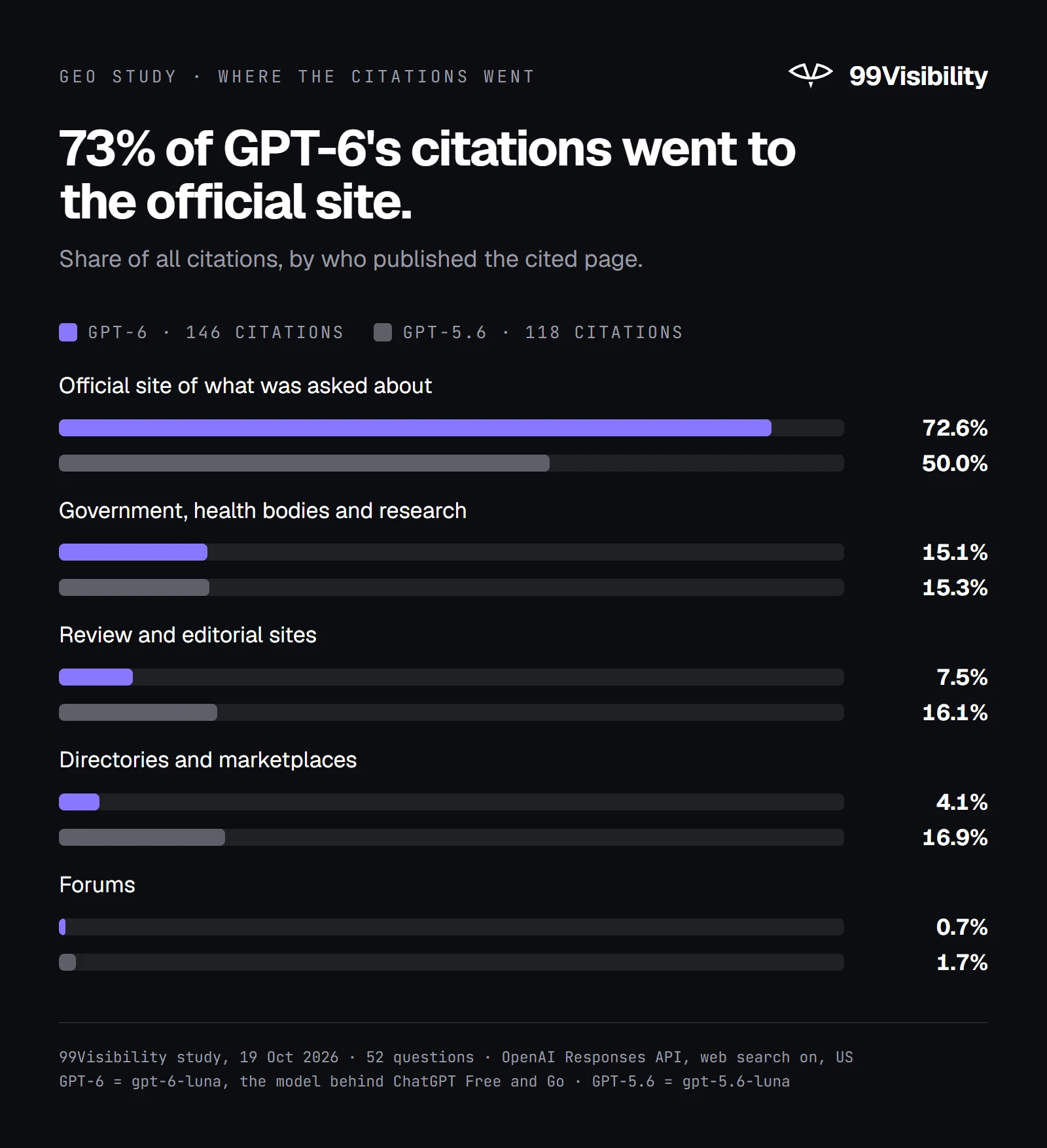
- 73% of GPT-6's citations went to the official site of what was asked about, against 50% for GPT-5.6.
- Citations to URLs that look like lists or reviews ("best", "top-10", "-vs-", "alternatives", "review" in the path) fell from 21 of 118 (17.8%) to 8 of 146 (5.5%).
- 140 of GPT-6's 146 citations (96%) were a specific page, not a homepage.
- GPT-6 now searches how-to questions: 7 of 8, against 2 of 8 for GPT-5.6.
- Asked the same question twice, GPT-6 cited 76% of the same sites but only 40% of the same pages.
What changed when ChatGPT moved to GPT-6
OpenAI announced GPT-6 on 7 October 2026. In its words, GPT-6 "starts rolling out globally to ChatGPT Plus, Pro, Business and Enterprise tiers today", and "Starting tomorrow, the rollout expands to Free and Go tiers"; it is "powered by GPT‑6 Sol for Plus, Pro, Business, and Enterprise tiers, and GPT‑6 Luna for Free and Go tiers" (GPT-6 and Intelligent UI for everyone, OpenAI). On search, OpenAI gives one number and one claim: "For questions that need web search, GPT‑6 Instant starts answering 44% sooner, on average, than GPT‑5," and "GPT‑6 also improves the quality of answers that require web search."
It does not say what changes in what gets cited. That is what we measured.
| Per answer, 52 questions | GPT-6 (gpt-6-luna) | GPT-5.6 (gpt-5.6-luna) |
|---|---|---|
| Answers that searched the web | 51 (98%) | 44 (85%) |
| Searches per answer | 2.5 | 0.9 |
| Pages retrieved per answer | 44 (2,277 in all) | 23 (1,184 in all) |
| Citations per answer | 2.8 (146 in all) | 2.3 (118 in all) |
| Share of retrieved pages cited | 6.4% | 10.0% |
| Answers with no citation at all | 1 | 8 |
The eight GPT-5.6 answers without a citation were the eight it did not search for: questions such as "How do I back up my iPhone?" and "How do I start a podcast?", which it answered from training data. GPT-6 searched for seven of the eight how-to questions and cited Apple's own support pages for the iPhone question and Apple's podcaster help pages for the podcast one. The only question GPT-6 answered without searching was "How do I prepare for a job interview?".
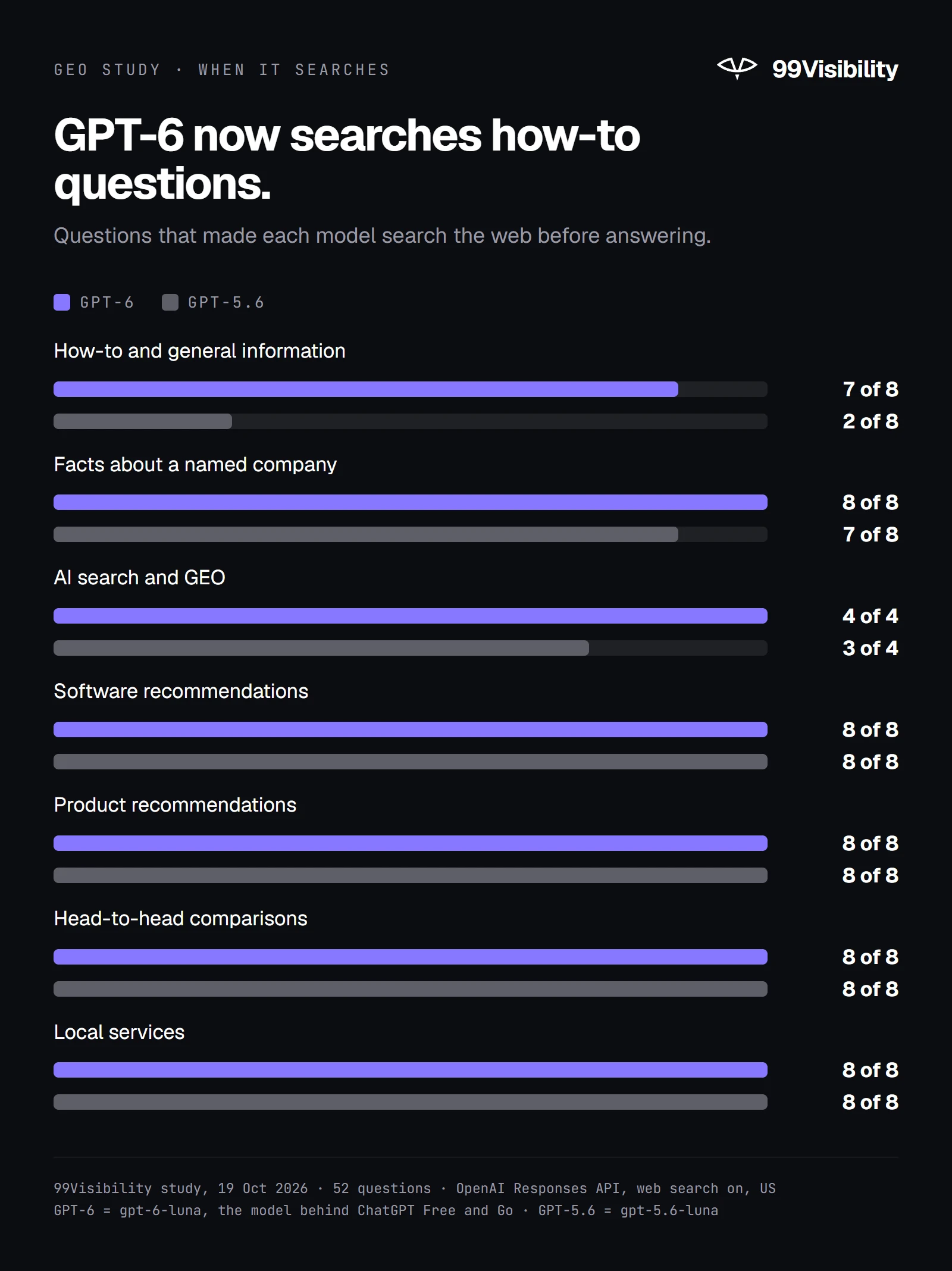
For anyone who publishes guides, that is the change that matters most. Questions the old model answered from memory, where no page could be cited, now trigger a search, and the answer links whatever it found.
What GPT-6 cites: the official source
We classified every cited URL by who published it, relative to the question: the official site of the product, company or service asked about (a vendor's pricing page, a brand's support page, a local business's own site); government, health bodies and research; review and editorial sites; directories and marketplaces; and forums. The classification of each URL is in the dataset.
| Who published the cited page | GPT-6, 146 citations | GPT-5.6, 118 citations |
|---|---|---|
| Official site of what was asked about | 106 (72.6%) | 59 (50.0%) |
| Government, health bodies and research | 22 (15.1%) | 18 (15.3%) |
| Review and editorial sites | 11 (7.5%) | 19 (16.1%) |
| Directories and marketplaces | 6 (4.1%) | 20 (16.9%) |
| Forums | 1 (0.7%) | 2 (1.7%) |
The shift was sharpest where the answer is a list of businesses. For "Good dentist in Seattle for a family?", GPT-5.6 cited Zocdoc, Opencare and two other directories; GPT-6 cited four practices' own websites. For "Best coworking space in New York City?", GPT-5.6 cited four list and marketplace pages and WeWork; GPT-6 cited four operators' own pages. Across the eight local questions, the official share rose from 12.1% to 47.8%. It did not happen everywhere: for "Best plumber in Austin, Texas?", both models cited Angi, Expertise.com and ConsumerAffairs. For the eight software questions, every one of GPT-6's 32 citations was a vendor's own page, 15 of them a pricing or plans page.
Product recommendations were the exception. Of GPT-6's 23 citations for the eight product questions, 8 went to review sites (RTINGS three times, Tom's Guide twice, and TechRadar, Runner's World and a copy of a Wirecutter review once each), 8 to manufacturers, and 7 to health and standards bodies such as the American Dental Association and the EPA. If your category is chosen by testing, the established reviewers are still a door you need.
It goes looking for the official page
GPT-6's own search queries show why. Of its 99 searches for the 52 questions, 58 (59%) used a site: operator to search a single website, and 36 of the 52 answers ran at least one. Forty-one of the 99 queries contained the word "official", and 41 named the year 2025 or 2026. A few, exactly as the model wrote them:
| Question | A search GPT-6 ran |
|---|---|
| What is the best CRM for a small business? | site:zoho.com/crm/zohocrm-pricing.html Standard $ per user month Zoho CRM USA |
| Who owns MyFitnessPal? | MyFitnessPal current owner 2026 ownership official |
| How do I get my website cited by ChatGPT? | site:help.openai.com ChatGPT search crawler OAI-SearchBot website citations |
That matches OpenAI's description of ChatGPT search, which "typically rewrites your query into one or more targeted queries" and "may send additional, more specific queries" after reviewing the first results (ChatGPT search, OpenAI Help Center). Our reading, which the data supports but does not prove: when a question has an official answer, GPT-6 searches for the page that states it, and cites that page if it finds the fact there.
Retrieved is not cited
Getting into the search results is necessary and nowhere near enough. GPT-6 retrieved 2,277 pages for the 52 questions and cited 146 of them, 6.4%. Its cited pages were almost always deep pages: 140 of 146 were a specific pricing, support, product or article page, not a homepage.
Reddit and Wikipedia are the clearest case. Both turned up constantly in GPT-6's search results and almost never made it into an answer. Reddit appeared in the results for 33 of the 52 questions and was cited in one, "Best gym in Miami?". Wikipedia appeared for 30 and was cited in none.
Two of GPT-6's citations were copies rather than originals: a staging server of The Knot's wedding marketplace, and a third-party proxy serving a Wirecutter review. A copy of a page that a crawler can reach can be the one that gets cited.
That runs against a common claim, that ChatGPT leans on Reddit and Wikipedia above all. For the questions we asked, on this model, on this day, it did not cite them. A different question set, a news question or a Plus account on GPT-6 Sol could give a different answer, and we have not measured those.
It also cuts against a widely shared finding that half of ChatGPT's citations are listicles, from Evertune's analysis of more than 40,000 cited URLs over 60 days (Jaclyn Ranere, LinkedIn, 6 May 2026). The two measurements are not the same: theirs predates GPT-6, classified pages differently and drew on their own platform's prompts; ours is 52 questions on one day, counted by URL pattern. Neither shows that a page format causes a citation.
Ask twice, get different links
We asked GPT-6 every question twice, minutes apart, with identical settings. On average 76% of the sites it cited the first time were cited again, but only 40% of the exact pages. For 4 of the 51 questions that produced a citation, the two runs shared no cited site at all. Between models the overlap was lower still: only 55% of the sites GPT-6 cited for a question were also cited by GPT-5.6 for the same question.
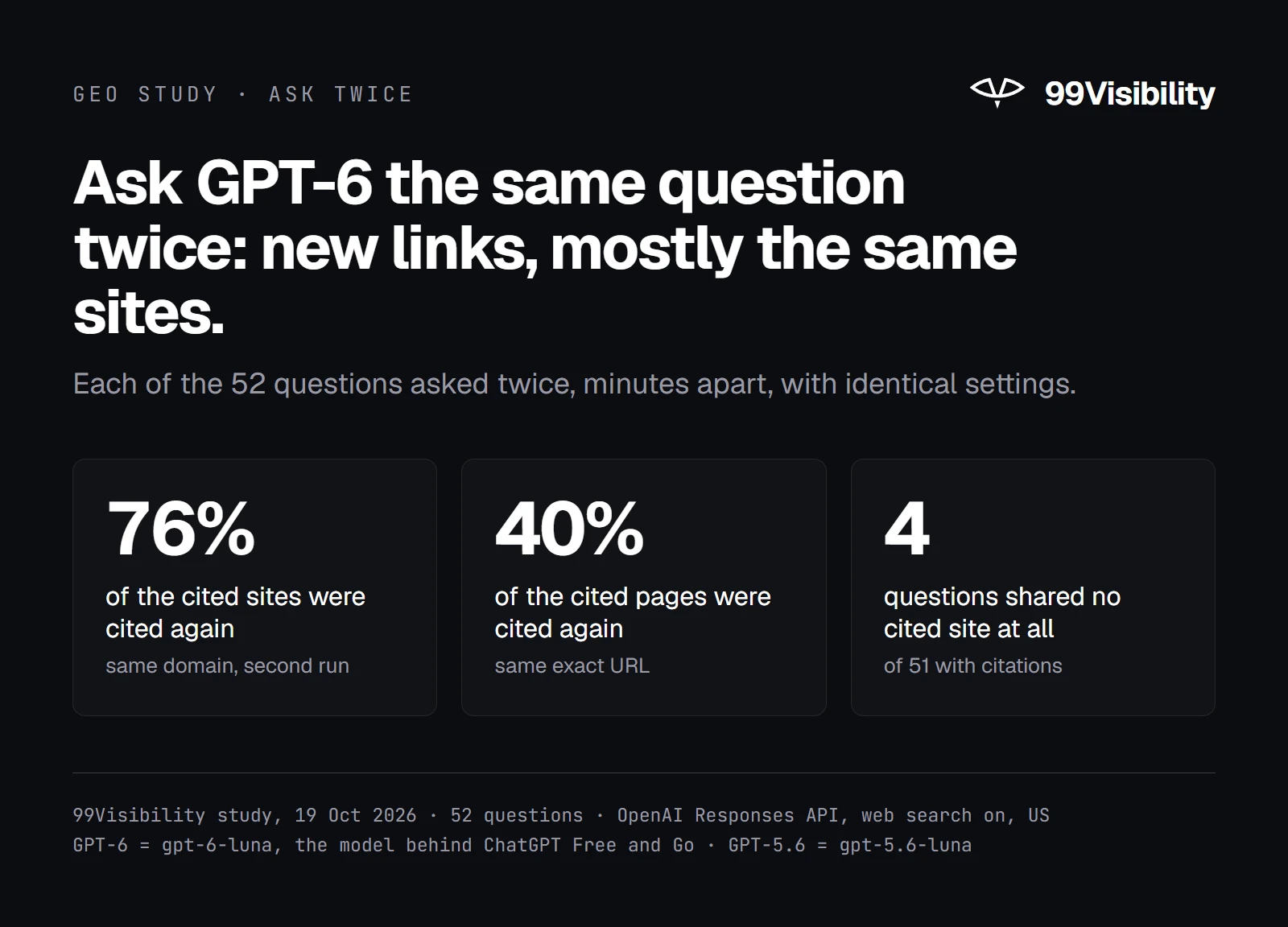
One screenshot of one ChatGPT answer is an anecdote. Whether you are cited is a rate, measured over repeated asks, and it moved by a lot when the model changed.
What ChatGPT cites about getting cited
We included four questions about AI search itself. Asked "How do I get my website cited by ChatGPT?", GPT-6 cited OpenAI's own documentation in both runs and nothing else: the crawler page on developers.openai.com and the help center. Asked how ChatGPT decides which websites to cite, it cited the help center's ChatGPT search article and nothing else. One of the help-center URLs it cited, a publishers' FAQ, now redirects to an unrelated article about ChatGPT Atlas being retired, a reminder that a cited page can move after the index saw it.
Asked "What are the best AI visibility tools?", GPT-6 cited the vendors' own sites: Peec AI, Semrush, Otterly.AI, Ahrefs and Profound in both runs, plus Scrunch in the second. It did not cite or even retrieve 99Visibility, for that question or any of the other 51. We publish that result because it is the result.
How to get cited by ChatGPT: what the data and OpenAI support
- Let OAI-SearchBot in, at robots.txt and at your firewall. This is the one documented requirement. OpenAI: "To make a website eligible for inclusion, allow OAI-Searchbot to crawl the site and confirm that the website host or content delivery network allows traffic from OpenAI's published searchbot IP addresses" (ChatGPT search). Sites opted out "will not be shown in ChatGPT search answers, though can still appear as navigational links", and a robots.txt change takes "~24 hours" to apply (OpenAI crawlers). GPTBot, the training crawler, is a separate switch; GPTBot vs OAI-SearchBot vs ChatGPT-User covers which to allow. Check yours with the free robots.txt checker, and the firewall half with the AI crawler checker.
- Be the page that states the fact. 73% of GPT-6's citations went to the official source, and its searches went looking for it by name and by site. If your price, plans, limits, opening hours, ownership or compatibility live only in a PDF, an image or a sales call, there is nothing for it to cite. State them in plain HTML on the page that owns them; the pricing page is where wrong AI answers most often start.
- Give each question its own page. 96% of the citations were deep pages. A homepage that mentions everything is rarely the link; the help article, the pricing page or the comparison page is.
- Keep the facts current, and date them. 41 of GPT-6's 99 searches named 2025 or 2026. That shows it is looking for this year's answer; it does not show that a date on the page earns the citation, and we did not test that.
- Answer the how-to questions in your field. GPT-6 now searches questions GPT-5.6 answered from memory, and cited the official how-to page when one existed (Apple's backup guide, Apple's podcaster help pages). That is new room for a company's own documentation.
- If reviewers decide your category, be on the reviewers. For physical products, review sites earned as many of GPT-6's citations as manufacturers did, 8 each of 23. Being tested by the outlets that test is the lever there, and it is not one you can publish your way into.
- Keep copies of your pages out of reach. GPT-6 cited a staging server and a proxy copy in this test. Put staging and preview environments behind a login or a noindex rule, so the page that gets cited is the one you maintain.
- Measure as a rate, on the current model. Ask the questions your buyers ask, more than once, and re-check when the model changes. Here the model change moved roughly half the cited sites.
What we did not test, and so do not claim: schema markup, llms.txt files, word counts, heading structure, or E-E-A-T signals. We did not vary any page, so this study cannot say what any of them does. Schema markup for AI and what llms.txt is and who reads it set out what the platforms themselves document about those.
Method
- When: 19 October 2026, 17:45 to 17:53 UTC.
- Models: gpt-6-luna, which OpenAI says powers ChatGPT's Free and Go plans, asked each question twice; gpt-5.6-luna, its predecessor, asked once. ChatGPT Plus and above run GPT-6 Sol, which we did not test.
- How: the OpenAI Responses API with the
web_searchtool available, an approximate US location, reasoning effort none, and a 2,000-token output limit. The model decided for itself whether and how often to search, as ChatGPT does. This is the method 99Visibility's audits use for their ChatGPT column; it is the API, not the ChatGPT app, and the app can differ. - Questions: 52 written as a buyer would type them, 8 in each of six types (software, consumer products, head-to-head comparisons, facts about a named company, how-to, local services) and 4 about AI search. Every question is in the dataset.
- Counting: a search is a web search call; a retrieved page is a source a search returned; a citation is a URL linked in the answer, counted once per answer, with OpenAI's tracking parameter removed. Sites are compared by registrable domain. Each cited URL was classified by hand.
- Cost: 156 answers and 311 web searches, about $3.43 at OpenAI's list prices.
- Limits: one day, one country, 52 questions chosen by us, and API answers rather than app answers. The numbers describe this test, not ChatGPT at large, and correlations here are not causes.
Data: gpt6-citation-study-2026-10-19.csv, one row per answer: model, run, question, whether it searched, its search queries, pages retrieved, and every cited URL with its classification. Use it with a link to this page.
FAQ
How do I get my website cited by ChatGPT?
Allow OAI-SearchBot in robots.txt and let OpenAI's published IP ranges through your firewall or CDN, which OpenAI names as the requirement. Then make sure the page that owns each fact states it plainly: in our GPT-6 test, 73% of citations went to the official site of what was asked about, and 96% to a specific page rather than a homepage.
Does ChatGPT cite Reddit and Wikipedia?
Rarely, in our GPT-6 test. Reddit appeared in the search results for 33 of 52 questions and was cited once; Wikipedia appeared for 30 and was cited in none. That is one day and 52 questions on GPT-6 Luna, so treat it as a measurement of that, not a rule.
Did GPT-6 change what ChatGPT cites?
In our test, yes. GPT-6 searched for 51 of 52 questions against 44 for GPT-5.6, read 44 pages per answer against 23, and sent 73% of its citations to official sites against 50%. Only 55% of the sites it cited for a question were also cited by GPT-5.6 for the same question.
Can I pay to be cited by ChatGPT?
No. ChatGPT's ads run separately from the answer; how ChatGPT ads work explains what they buy. Citations come from search, and the documented way in is OAI-SearchBot access and a page that answers the question.
For how citations are displayed and when ChatGPT links at all, see ChatGPT citations; for where ChatGPT's search results come from, see what search engine ChatGPT uses.
See what ChatGPT cites for your own questions. Run a free AI visibility audit: it asks ChatGPT the way this study did and checks that OAI-SearchBot can reach you. No credit card.
Want more of our research in Google Search and AI Mode? Add us as a preferred source.
See what AI says about your brand
Your free audit asks ChatGPT and Google AI Overviews about your brand. Paid plans add Gemini, Perplexity and Claude, and show every answer that contradicts your facts.
Start for Free- ChatGPTMentioned, 2nd of 5 brands
- Google AI OverviewsNot mentioned
- PerplexityMentioned and cited as source [1]
- ClaudeSays $29/mo. Your pricing page says $49/mo.

Related Articles
ChatGPT Citations: When ChatGPT Links a Source, and Whether It Can Link Yours
ChatGPT only cites sources when it searches the web. What OpenAI documents about when that happens, why some citations are wrong, and what decides whether ChatGPT can cite your site at all.
GPTBot vs OAI-SearchBot vs ChatGPT-User: Which OpenAI Crawler to Allow
GPTBot collects training data. OAI-SearchBot decides whether ChatGPT search can show your site. ChatGPT-User fetches pages live, and robots.txt may not apply to it. What OpenAI says each one does, a decision table by goal, and the firewall rule robots.txt cannot fix.

What Search Engine Does ChatGPT Use? And Is It Elasticsearch?
OpenAI names Microsoft and Shopify as ChatGPT search providers, plus its own crawler. What each AI engine documents about its search, and why Elasticsearch is not your lever.